
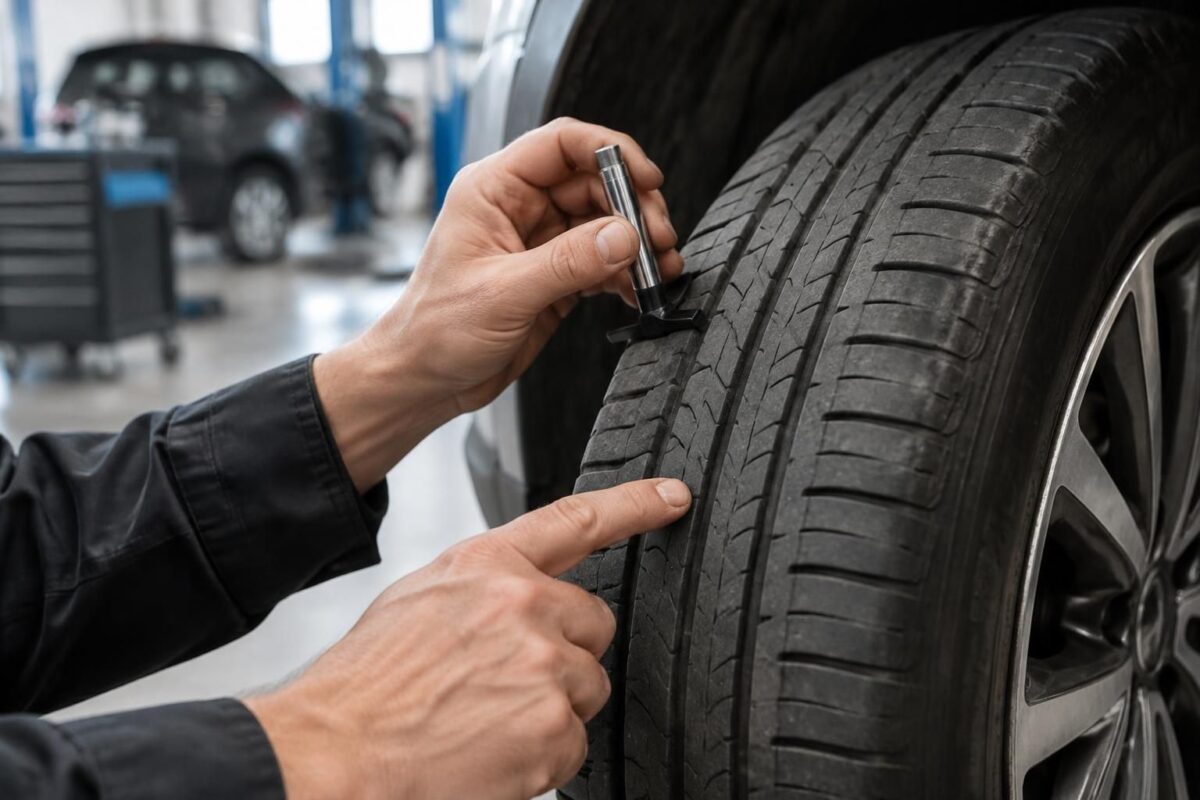
Car safety: Is the tread wear indicator really enough to decide?
Hi, Nathan here. No: the wear indicator marks the legal limit, but it isn’t enough on its own to decide whether your tires are still safe for the road. Also check wear across the entire tread, the condition of the sidewalls, and tire pressure. If the tread is approaching the wear indicator, especially before a rainy period, have the tires checked and plan to replace them without waiting until the last millimeter.
WHAT TO DO NOW
- Look for the triangle or TWI marking on the sidewall, then find the small bar in the corresponding groove.
- Check several grooves and several spots around each tire: wear can be uneven.
- Inspect the sidewalls for cuts, cracks, or bulges.
- Check the tire pressure when the tires are cold, using the values shown on the vehicle’s label or in the manual.
- If the tread reaches the level of the wear indicator, limit your trips and arrange to replace the tires.
Wear indicator: a legal benchmark, not a green light to wait
The wear indicator is a small raised bar molded into the bottom of the main grooves. When the tread reaches its height, the tread depth has reached the legal limit of 1.6 mm for a passenger-car tire in France. The tire must then be replaced.
But this limit does not guarantee optimal road grip. In the rain, shallower grooves are less effective at dispersing water: the risk of hydroplaning increases and braking distances can grow. The indicator therefore marks a regulatory threshold, not a driving target.
In many cases, it’s wise to replace the tires before the tread gets down to around 3 mm, especially if you often drive in the rain. This guideline varies depending on the tire, the vehicle, and your journeys: ask a professional for advice if you’re unsure.
How to check tire wear without relying on just one spot
On the sidewall, look for a triangle, an arrow, or the letters TWI. These markings show you where to look, but they don’t measure wear. Follow their alignment to the groove and compare the tread height with the wear indicator.
Repeat this on several grooves and at several spots on the tire. More pronounced wear in the center, on the inside, or along the edges may indicate incorrect pressure or an alignment problem. To learn how to spot these differences, see this guide to spotting abnormal tire wear without going to a garage.
A coin slipped into a groove can only provide a rough indication. It is no substitute for the built-in wear indicator or a check with a suitable measuring device: a single measurement taken in the wrong place can give you a false sense of security.
Three steps to decide what to do
- Step 1: Park on a flat surface, switch off the engine, then turn the wheel slightly if the wear indicator isn’t visible.
- Step 2: Check several areas of the tread and examine the sidewalls. Note any uneven wear, bulges, or cuts.
- Step 3: If a wear indicator is flush with the tread, have the tire replaced. If the wear is uneven or you notice an issue, also ask to have the tire pressure and running gear checked.
Visible wear, pressure, and damage: signs you shouldn’t confuse
A tire can be properly inflated and still be worn. Conversely, pressure that is too low or too high isn’t always obvious at first glance and can accelerate uneven wear. Tire checks should therefore include both of these complementary inspections.
Check the pressure about once a month and before a long trip, preferably when the tires are cold. To understand how incorrect inflation wears down the tread, also read these tips on correct tire pressure.
A bulge on the sidewall needs prompt attention: it may indicate internal damage after hitting a curb or a pothole. If the car pulls to one side, the steering wheel vibrates, or one tire wears significantly faster than the others, have the vehicle inspected.
| What you notice | What it may indicate | What to do |
|---|---|---|
| Tread level with the wear indicator | Legal limit reached | Plan to replace the tire promptly |
| More pronounced wear in the center or along the edges | Incorrect pressure, among other possible causes | Check the pressure and ask for an inspection if the issue persists |
| Wear on one side only | Possible alignment or running gear problem | Have the vehicle inspected |
| Bulge, cut, or crack | Possible damage to the tire’s structure or sidewall | Have the tire examined promptly |
Two real-world situations: when to replace or have your tires checked
If the wear indicator is flush with the tread in one part of the tire: don’t rely on areas that still seem fine. Localized wear is enough to warrant a prompt inspection and may mean the tire needs to be replaced.
If the wear indicators are still well below the tread, but the car vibrates or pulls to one side: the tire may not be at the end of its life, but a wear, pressure, or alignment problem is possible. Have the cause checked before a long trip.
A common mistake is to check only the outside, which is easy to see when the car is parked. The inside may be more worn: turn the wheels if necessary, or ask a garage to inspect them.
Why the wear indicator doesn’t tell the whole story about vehicle safety
The wear indicator shows the tread depth, but not sidewall damage, rubber aging, or tire pressure. Nor does it warn you about a wheel-alignment problem. For a more complete picture, you can read about the signs that mean you should avoid the highway.
Vehicle safety depends on several simple checks, especially before a heavily loaded trip or in bad weather. A few minutes of inspection can reveal a problem that the dashboard won’t flag: the wear indicator never lights up.
See where the wear indicator is located
A visual demonstration can help you spot the small raised bar in the grooves and understand when it becomes flush with the tread. Keep in mind, though, that you need to check several areas of the tire.
Frequently asked questions about the wear indicator
Where is a tire’s wear indicator located?
It is located in the main grooves of the tread. A triangle, an arrow, or the letters TWI on the sidewall helps you locate the groove.
Should you wait until the wear indicator is reached before changing tires?
No. The wear indicator marks the legal limit of 1.6 mm, but performance on wet roads can already decline before that point. Replacing the tires early, often at around 3 mm depending on the tire and its use, maintains a safety margin.
Does a tire pressure warning light replace a wear check?
No. The warning light monitors pressure irregularities, not tread depth. A tire can be correctly inflated and worn, or underinflated without being close to the wear indicator.
How many wear indicators should you check on a tire?
Check several wear indicators, ideally in different places and in several grooves. Uneven wear can cause one area to reach the limit before the others.
Thanks for your interest; Nathan