
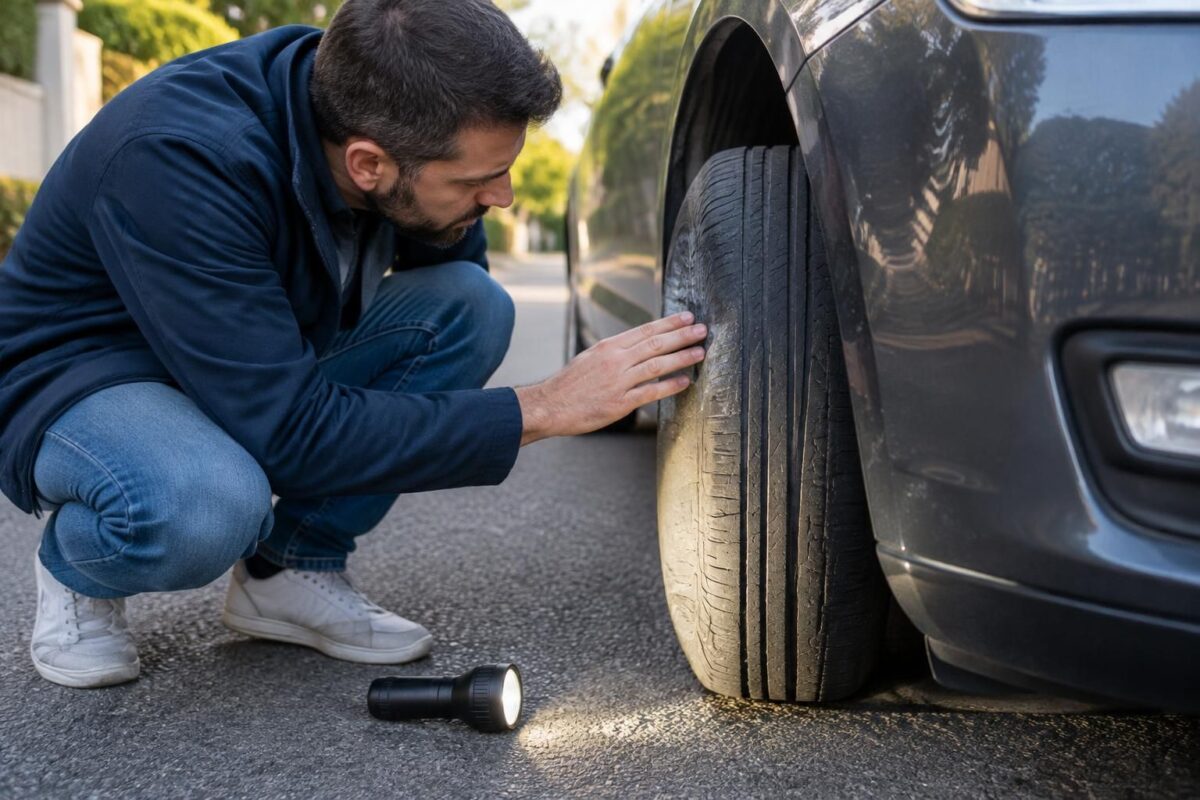
Tires: how to spot abnormal wear without a garage
Hi, Nathan here. Compare the tread depth, inspect both edges and the sidewalls: concentrated wear, cracks or a bulge can be spotted without garage equipment. Do this check when the tires are cold, with the car stopped on level ground, and check each tire in several places. The wear indicator marks the legal limit of 1.6 mm; in wet conditions, it’s better to plan for replacement before reaching it.
WHAT TO DO NOW
- Park the car on level ground, switch off the engine, and turn the wheels if necessary to get a better look at the front tires.
- Inspect the tread across its full width and rotate the wheel to examine its entire circumference.
- Locate the wear indicators at the bottom of the main grooves and check whether the tread has reached their level.
- Look at the sidewalls for cracks in the tires, cuts or tire deformation, such as a bulge.
- Check the tire pressure when the tires are cold, following the value shown on the vehicle’s label or in its manual.
Spotting abnormal tire wear by eye
Even wear is generally spread across the entire tread. Gently run your hand over the rubber: ridges or rougher areas can indicate uneven wear, even if the tire looks fine from a distance.
Also inspect the sidewalls. A small surface crack warrants monitoring, but a bulge, deep cut or visible deformation calls for a prompt inspection by a professional. A bulge on the sidewall may indicate internal damage after hitting a curb or pothole.
| Observed appearance | Possible cause | Useful action |
|---|---|---|
| Wear mainly in the center | Excessive pressure, sometimes depending on the vehicle and its use | Check the pressure when cold and adjust it to the recommended values |
| Wear on the shoulders, the edges of the tire | Possible underinflation, or a heavy load | Check the pressure and monitor how it changes |
| One side is smoother than the other | Misaligned wheels or incorrect alignment, often after an impact | Have the suspension and wheel alignment checked at a workshop |
| Wavy or sawtooth wear | Suspension, shock absorbers or alignment need checking | Ask for a diagnosis, especially if the noise gets louder |
Read the signs without jumping to conclusions
Wear in the center suggests overinflation; wear on both edges often points to low pressure. These are clues, not a definitive diagnosis: the load, vehicle model and condition of the components can also play a part.
If the tire wears more on one side, incorrect alignment is a common cause, particularly after an impact. Correcting the pressure alone won’t solve the problem; a new tire may then wear in the same way. To understand a common case, see the guide to wear concentrated in the center of the tire.
Steering wheel vibrations can accompany uneven wear, but they can also be caused by an unbalanced wheel or another component. If they start suddenly, get stronger as your speed increases or come with unusual noise, have the car checked.
Check tread depth in three steps
- Step 1: Find the small rubber bars at the bottom of the main grooves. “TWI” markings or a symbol on the sidewall often show where to look for the wear indicator.
- Step 2: Measure or compare several grooves, on the inside, center and outside of the tire. A tread depth gauge gives a more reliable reading than a coin.
- Step 3: If the tread has reached the indicator, the tire is at about 1.6 mm: this is the legal limit in France. In practice, replacement at around 3 mm may be preferable if you often drive in the rain.
A €1 coin can serve as a rough guide, not a precise measurement: if its gold-colored edge remains visible in the groove, the depth may be close to or below 3 mm. Check with a gauge or ask for an inspection. To complement this check, here are three pointers for checking tire pressure without guessing.
When tire wear calls for a professional inspection
Incorrect pressure is easy to correct, but diagonal, wavy or sawtooth wear can indicate an alignment or suspension problem. A visual tire check does not replace an inspection of these components, especially if the car pulls to one side or the steering wheel vibrates.
If the wear is in the center or on both shoulders: first check the pressure when the tires are cold and compare it with the manufacturer’s recommended values. If it’s on one edge, or there’s a bulge or deep cut: don’t put off the diagnosis; structural damage can make the tire dangerous.
A tire that is more than ten years old should be examined carefully, even if it appears to have little wear. Its manufacturing date can be read from the four-digit code on the sidewall; age alone does not replace an inspection of its condition.
Simple checks to make part of your routine
A monthly check takes a few minutes and helps you spot pressure loss or uneven wear early. Also remember to check the tires again after a significant impact or before a long trip with a heavy load.
If you’re replacing only two tires, confirm the right setup for your vehicle. In many cases, the new tires are fitted at the rear to maintain stability, but the manufacturer’s recommendations and the vehicle’s requirements should still be checked.
Frequently asked questions about tire wear
What is the legal limit for tire wear?
In France, tread depth must not fall below 1.6 mm. The wear indicator built into the tire is at this height; in wet conditions, it is often better to replace the tire before reaching this limit.
Can a €1 coin measure tire tread depth accurately?
No. It only provides a rough guide of around 3 mm, depending on the groove and how the coin is inserted. A tread depth gauge is more reliable.
Why does a tire wear on one side only?
Incorrect wheel alignment or geometry is a common cause, sometimes following an impact with a curb or pothole. A professional can confirm the cause and adjust the alignment.
Can I drive with a bulge on the sidewall?
A bulge may indicate internal damage. Avoid continuing to drive as normal and have the tire checked promptly; it may need to be replaced.
Thanks for your interest; Nathan