Car Repair: The Hidden Problem Behind a Simple Shimmy
Hello, Nathan here. A shimmy is often caused by an imbalance, a deformed tire, or play in the front end: have the wheels and steering checked before replacing any parts. If the steering wheel vibrations are severe, get worse, or are accompanied by a noise, limit your driving and request an automotive diagnosis. The right approach is to identify when the problem occurs, then check the possible causes in the right order.
WHAT TO DO NOW
- Note the speed at which the shimmy starts and whether it occurs while accelerating, braking, or driving at a constant speed.
- Check your tire pressure when the tires are cold and inspect their surface: a bulge, uneven wear, or deformation should be checked promptly.
- Check whether a wheel balancing weight is missing, without trying to put it back yourself.
- Avoid high-speed roads if the steering wheel shakes severely or the car pulls to one side.
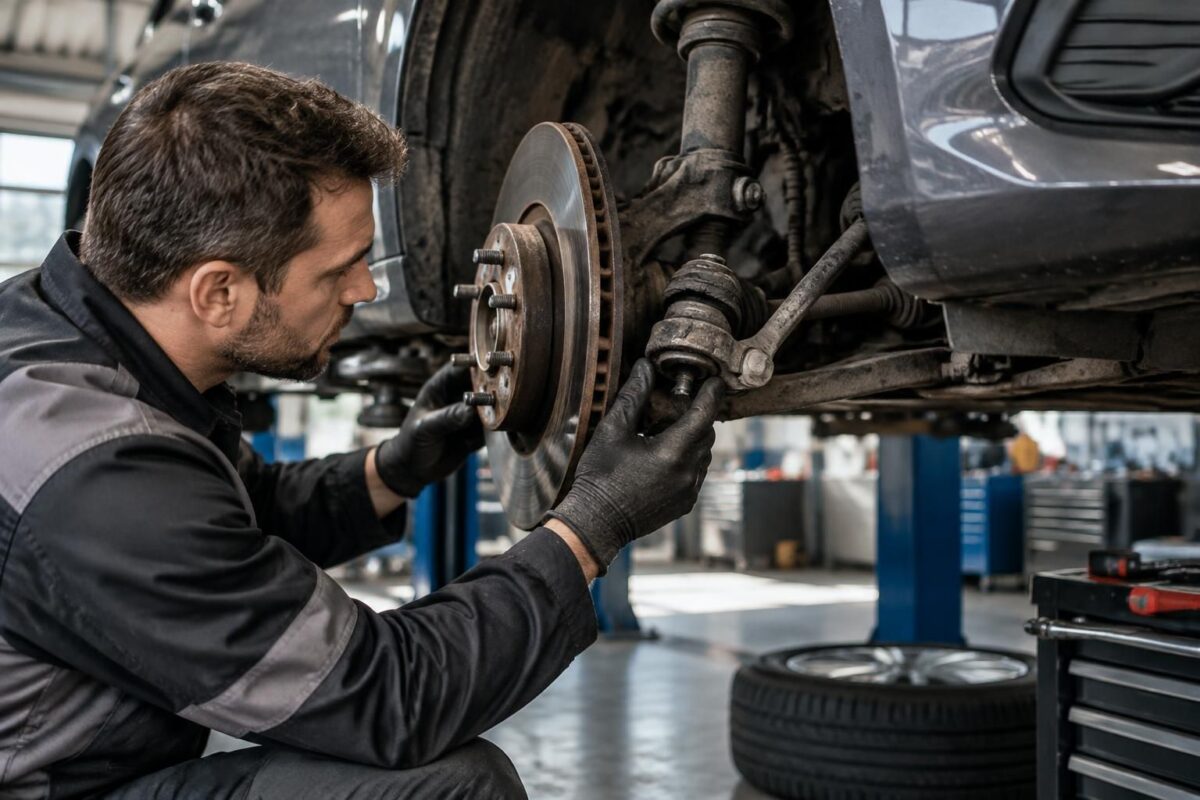
- Ask to have the front end checked, including the tie rod ends, suspension, and wheel bearings.
Shimmy and steering wheel vibrations: what the symptom reveals
The word shimmy describes a repeated shaking, often felt through the steering wheel. It can occur within a specific speed range, then ease off as you slow down: this is a useful clue, but it does not prove that wheel balancing is the cause.
For example, if the vibrations start mainly at high speeds, an unbalanced wheel or a damaged tire are among the first things to consider. If they occur while braking, the brakes should also be checked. Play in the steering or a worn wheel bearing can also make the problem worse.
| When the shimmy occurs | Possible causes | Recommended check |
|---|---|---|
| At a specific speed | Incorrect balancing, deformed tire, damaged wheel | Tire inspection and wheel balancing |
| While braking | Possible fault in a disc or brake component | Brake system inspection |
| On a bumpy road or while cornering | Possible play in the tie rod ends or suspension | Inspection of the front end and joints |
| With a rumbling noise that changes while driving | Possibly worn wheel bearing | Workshop diagnosis; don’t wait if the noise gets louder |
Tire, wheel, or steering: how to narrow down the possibilities
A tire may look fine at first glance and still have a deformation on its tread or sidewall. A bulge, scalloped wear, or vibration that started after hitting a pothole warrants a professional inspection.
Wheel alignment should also be checked if the car pulls to one side or if the tires wear unevenly. But an alignment adjustment will not fix a damaged tire or a tie rod end with play: the defective part must be identified first.
Automotive diagnosis: the three-step process
- Step 1 – Describe the symptom precisely. Note the speed, how often the vibrations occur, and the circumstances: braking, accelerating, cornering, or uneven road surfaces. Don’t drive fast to try to make the shimmy happen.
- Step 2 – Have the wheels and tires checked. A professional will check their condition, how they are secured, and their balance. If the shaking continues, the inspection will move on to the tie rod ends, suspension, and wheel bearings.
- Step 3 – Fix the cause before the final adjustment. Once a worn part or defective tire has been replaced, the repair shop can check the wheel alignment if the symptoms or wear warrant it. Ask to see the part causing the problem and the inspection results.
Two quick scenarios to help you decide what to do
If the steering wheel shakes at a constant speed, especially within an identifiable speed range, start by having the tires and wheel balance checked. A recent impact or vibrations that started just after a tire change are important details to share.
If the shaking occurs while braking, or if you hear a clunk when turning, don’t limit the check to wheel balancing. The brakes and front end need to be inspected to locate the problem before you resume normal driving.
Repair the problem without replacing parts at random
A common mistake is to ask for a wheel alignment as soon as the car vibrates. But if a tire is deformed or a joint has play, the adjustment won’t eliminate the cause of the shimmy. Mechanical components should be checked first.
Video tutorials can help you understand where parts are located and prepare for a simple repair. CarCareKiosk, for example, offers instructional videos for different car models; always check that the vehicle and procedure match yours exactly. A video cannot replace an inspection on a lift when it is necessary to detect play or an internal fault.
When a shimmy requires prompt inspection
If the vibrations become violent, the steering feels loose, or a bearing noise gets louder, pull over somewhere safe and ask a professional for advice. A tire with a bulge or a severely worn steering component can make the car difficult to control.
If the shaking remains mild and steady, still have the vehicle checked soon, especially before a long trip. A shimmy is a symptom to diagnose, not a part to replace at random.
Frequently asked questions about shimmy and steering wheel vibrations
Will wheel balancing alone always be enough?
No. It can correct vibrations caused by an unbalanced wheel, but it won’t fix a deformed tire, a worn tie rod end, a faulty bearing, or a braking problem.
Can wheel alignment cause a shimmy?
Incorrect wheel alignment is more likely to make the car pull to one side or cause uneven tire wear. A tire, wheel, or front-end fault should also be investigated.
Can I keep driving if the steering wheel shakes?
It depends on how severe it is and whether there are other symptoms. If there are severe vibrations, noise, unstable steering, or a deformed tire, pull over safely and have the car checked promptly.
What should I ask the repair shop to check for an automotive diagnosis?
Ask them to check the tires, wheel balance, wheel fasteners, front end, tie rod ends, and wheel bearings. If the vibrations occur while braking, mention it so the brakes can also be inspected.
Thank you for your interest; Nathan