Vehicle Maintenance: When a Vibration Becomes More Than a Minor Detail
Hi, Nathan here. If a vibration persists, note when it occurs, check the tires, and have the vehicle inspected promptly, especially if braking or steering changes. A vibration in the steering wheel, in the seat, or while stationary does not point to the same fault. The wheels, suspension, brakes, and engine could all be involved. Early diagnosis helps protect your road safety and avoid more extensive repairs.
WHAT TO DO NOW
- Note the speed and when the vibration starts: accelerating, braking, turning, or stopping.
- Check tire pressure when the tires are cold and inspect their condition, including the sidewalls.
- Check whether a wheel appears damaged or a wheel-balancing weight is missing.
- Avoid driving at high speeds if the shaking is severe or getting worse.
- Make an appointment promptly if you hear a rumbling or clunking noise, or if the car pulls to one side.
Vibration while driving: what the timing can tell you
A vibration that increases with speed often comes from the wheels, tires, or wheel balance. If you feel it mainly in the steering wheel, the front of the vehicle should be checked first; if it travels through the seat or floor, the rear wheels or suspension may be involved.
At around 80 to 110 km/h, depending on the model and circumstances, an imbalance can sometimes become more noticeable. Hitting a curb or a pothole can also deform a wheel rim or affect the alignment. To better identify which initial check to request, see this guide to steering wheel vibration and the initial check.
A vibration that occurs while stationary with the engine running points more toward the engine or its mounts. If it happens only while accelerating, the transmission or a CV joint may also be involved. The exact timing of the symptom is often more useful than a long list of guesses.
Vibrations when braking: a warning to take seriously
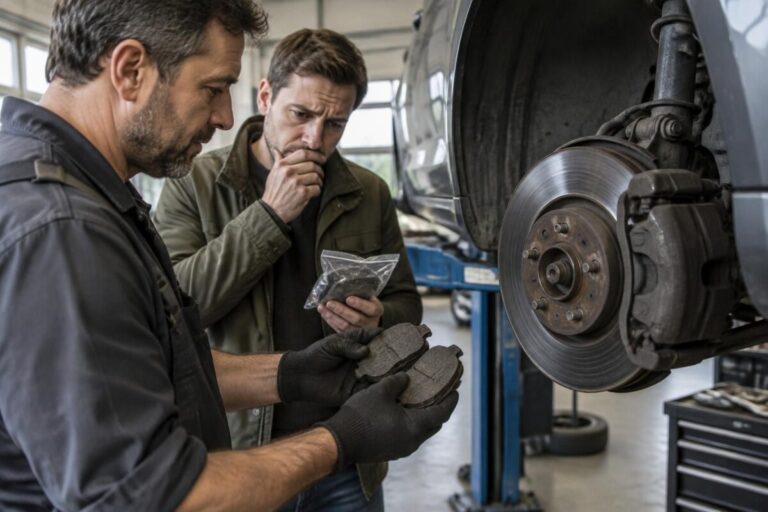
If the steering wheel or pedal shakes only when you brake, the rotors may be warped or unevenly worn. A sticking caliper or improperly tightened wheel can also contribute to the problem.
A pedal that pulses slightly is not as serious as braking that pulls to one side, becomes less effective, or is accompanied by a metallic noise. In the latter case, stop as soon as you can do so safely and have the vehicle inspected without continuing your journey.
Diagnosing a vibration: useful checks to make
Before going to the garage, note the conditions under which it occurs. Do not try to reproduce the symptom at high speed: a road test should be done cautiously and only if the car handles normally.
- Step 1: Check the tires. Check their pressure when cold, tread wear, and look for bulges, cuts, or deformation. Incorrect pressure can amplify shaking; these tips on checking tire pressure regularly can help you avoid this common oversight.
- Step 2: Note the circumstances. Record whether the vibration occurs at a particular speed, when braking, turning, or accelerating. Also note whether you feel it in the steering wheel, seat, pedals, or throughout the cabin.
- Step 3: Have the relevant components checked. A professional can check the wheel balance, alignment, brakes, wheel bearings, suspension, and engine mounts. Never get under a car supported only by a jack.
One practical detail: after a tire change, a wheel may appear to be fitted correctly even though a wheel-balancing weight came loose shortly afterward. If the shaking starts around that time, let the garage know.
Possible causes based on the symptoms
| What you notice | Possible causes | Useful next step |
|---|---|---|
| Steering wheel shakes mainly at higher speeds | Wheel imbalance, deformed tire, damaged rim, or play in the steering | Have the wheels inspected and the balance checked |
| Vibration only when braking | Worn or warped rotors, malfunctioning caliper | Have the braking system checked promptly |
| Shaking while stationary with the engine running | Engine mounts, ignition, or engine fuel supply | Request a mechanical diagnosis |
| Vibration when accelerating | Transmission, CV axle, or engine mounts | Avoid hard acceleration and have the vehicle inspected |
| Car pulls to one side and tires wear unevenly | Alignment, suspension, or steering | Have the alignment and suspension components checked |
Repairs and costs: what to expect
The cost depends on the part involved, the vehicle, and local rates. Wheel balancing often costs a few dozen euros per wheel; an alignment usually costs several dozen euros. Replacing a tire or suspension component can bring the bill to a few hundred euros, depending on the model and circumstances.
Ask for an estimate that separates the diagnosis, parts, and labor. If the garage suggests replacing several components, ask which checks confirm that they are worn. To distinguish a wheel problem from simply incorrect tire pressure, you can also read this article about vibration or tire pressure.
The final check matters just as much as the repair: after the work, the professional should make sure the symptom has gone away and that the vehicle brakes and drives normally. A persistent vibration should not be considered fixed simply because the wheels were recently balanced.
If it’s mild… / If it’s accompanied by another symptom…
If it’s a mild vibration at a specific speed, with no noise or change in handling, reduce your speed and schedule a check of the wheels and tires. Balancing or inspecting a rim may be all that’s needed.
If the vibration comes with a loud noise, imprecise steering, or reduced braking performance, stop in a safe place and have the car towed. Continuing to drive may worsen the fault and compromise safety.
Car maintenance: preventing vibrations from returning
Regular checks help prevent unpleasant surprises. Check tire pressure about once a month and before a long trip, ideally when the tires are cold; also inspect tire wear and the condition of the rims.
Have the wheels balanced when tires are changed or if a vibration appears. The alignment should be checked after a significant impact, if the car pulls to one side, or if the tires wear unevenly. The interval depends on the vehicle and how it is used: follow the manufacturer’s recommendations rather than sticking to an arbitrary mileage interval.
Smooth driving also helps the brakes and suspension last longer. After a long downhill stretch, avoid driving through a large puddle immediately if the brakes are very hot: sudden cooling can increase stress on the rotors.
FAQ: car vibrations
Can you keep driving with a vibration?
A mild, steady vibration calls for an inspection soon, but avoid driving at high speeds. If it gets worse or is accompanied by a loud noise, imprecise steering, or abnormal braking, stop as soon as you can do so safely and have the car inspected.
Does a steering wheel vibration always come from the tires?
No. An imbalance or damaged tire is common, but the steering, wheel bearings, brakes, or suspension may also be involved. When the vibration occurs can help guide the diagnosis.
How much does it cost to repair a vibration?
The price varies depending on the fault and the vehicle. Wheel balancing often costs a few dozen euros per wheel; repairs to the brakes, suspension, or transmission can cost several hundred euros. Ask for an estimate after diagnosis.
What should you check first if the car shakes?
Start by checking the tire pressure and condition, then note the speed and circumstances in which the vibration occurs. Do not remove a wheel unless you have the proper equipment and a secure lifting support.
Thanks for your interest; Nathan